

How to Claim a Japanese Tax Refund in 2026
A tax-free purchase in Japan can still leave you without a refund. The National Tax Agency's traveller guidance makes Customs confirmation essential: buying eligible goods isn't enough if you cannot demonstrate that you're taking them out of Japan.
Are you Visiting Japan soon?
Let us make your trip effortless. From tickets and hotels to transport and local guides, we arrange everything for you or your group. Whether it’s a music festival in Tokyo or a business conference in Osaka, our custom travel service ensures you enjoy the event stress-free.
Contact Jasumo Now →The practical way to protect a Japanese tax refund is to maintain an auditable chain from purchase to personal export. Your eligibility, purchase records, goods and departure confirmation must match. This guide concerns visitors' consumption-tax refunds, not income-tax refunds on salary or other earnings.
Table of Contents
- How the Japanese Tax Refund Works from November 2026
- Who Qualifies and What Each Purchase Refunds
- How to Buy at Participating Shops Step by Step
- How to Clear Customs and Collect Your Refund
- Mistakes That Cost Travellers Their Refund
- Frequently Asked Questions
- Pre-Departure Checklist and Support
How the Japanese Tax Refund Works from November 2026
Since 1 November 2026, eligible visitors pay first and receive their refund after Customs confirms export, rather than having consumption tax removed at checkout, according to the National Tax Agency's reform report. The shop or its approved refund partner returns the consumption-tax equivalent; Customs verifies export but doesn't operate a universal airport cash-refund counter.
The previous checkout exemption applied until 31 October 2026, while the revised method requires export within 90 days of purchase, as explained in the Japan Tourism Agency's transition guidance.
Tax-free checkout compared with refund after departure
| Point | Until 31 October 2026 | From 1 November 2026 |
|---|---|---|
| When the tax is removed | At the till | After Customs confirms export |
| What you pay on the day | Price excluding consumption tax | Tax-inclusive price, including 10% consumption tax on standard-rated goods |
| Customs step | Goods and passport shown on departure | Goods and passport presented and export confirmed before refund |
| Export deadline | Goods taken out of Japan | Exported within 90 days of purchase |
| Who returns the tax | Not applicable, tax not paid | Shop or approved refund partner |
The rate distinction matters. Japan's standard consumption tax is 10%, while qualifying food and beverages generally attract 8%, excluding alcohol and dining out, as summarised in Zurich Kotak's Japan shopping guide.
The timeline below shows the purchase-to-refund sequence.
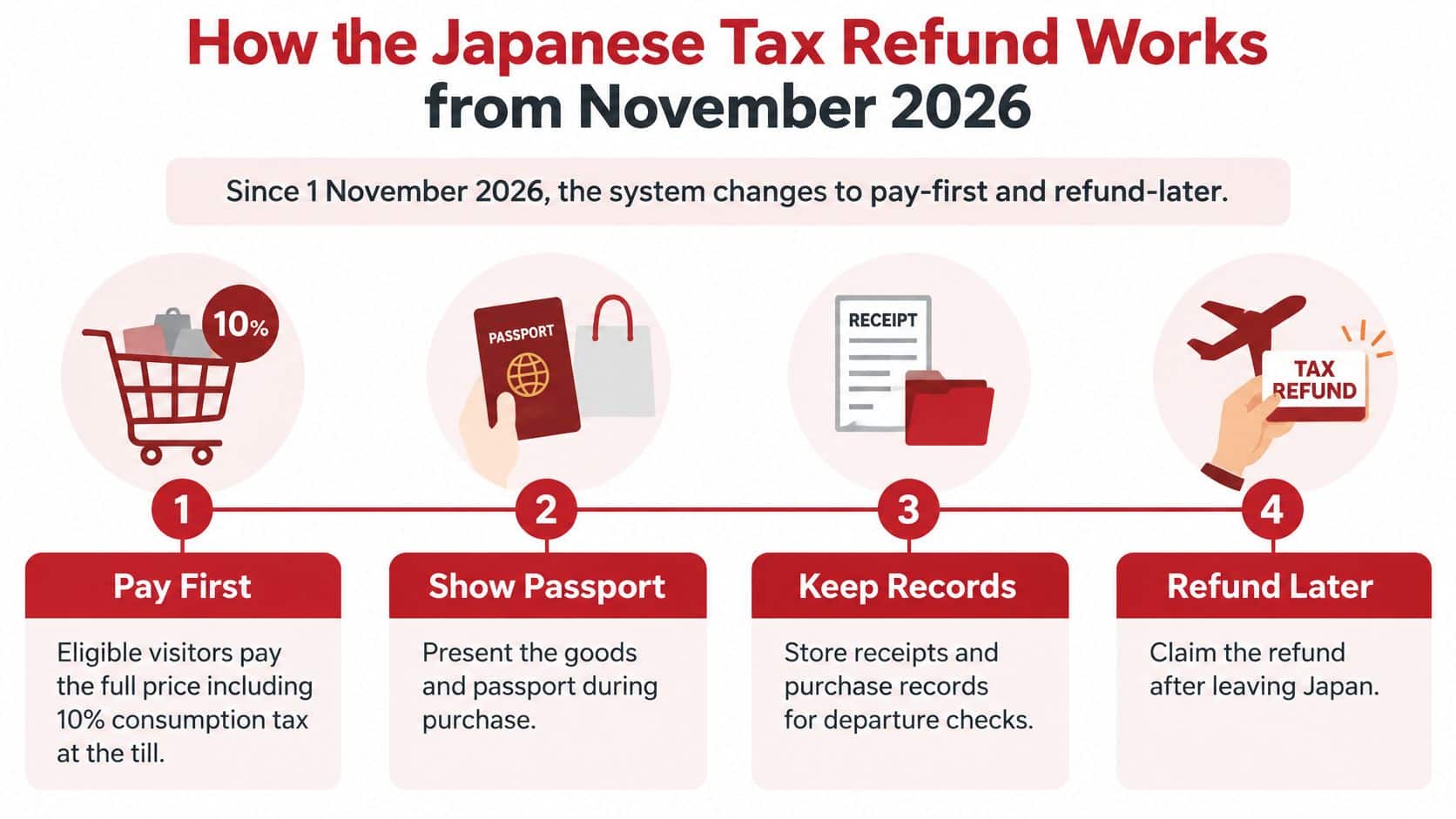
For scale, international visitors spent approximately ¥2.4 trillion on shopping in Japan in 2024, according to the Japan Tourism Agency. Shopping represented approximately 29.5% of total visitor expenditure that year, according to figures attributed to the agency.
Refund routes can include cards, bank transfers, apps or cash. Ask which route the shop uses before committing your money, and budget for reimbursement after departure rather than an immediate discount.
If you're considering volunteering trips to Japan through HeyLocals, check your immigration status separately from your itinerary. The purpose of a trip doesn't establish shopping eligibility.
These rules are stated as of 2026. Confirm current National Tax Agency guidance before travelling.
Who Qualifies and What Each Purchase Refunds
Status matters more than nationality. The National Tax Agency's eligibility guidance identifies qualifying non-residents, including people admitted under Temporary Visitor, Diplomat or Official status and other specified categories. A foreign national with ordinary Japanese residence status does not qualify only by holding an overseas passport.
Carry your passport and ensure the shop checks your landing-permission information. A hotel booking, foreign payment card or return ticket isn't a substitute for the eligibility check.
The minimum is ¥5,000 excluding tax at the same shop on the same day, according to Japan Customs. Purchases from separate shops cannot be pooled.
Match the refund to the tax actually charged
The following worked examples use a hypothetical ¥10,000 pre-tax purchase. They calculate the tax component using the applicable rates, rather than treating every purchase as standard-rated.
Refundable tax by purchase category
| Category | Tax rate | Refund condition |
|---|---|---|
| General goods such as clothing and souvenirs | 10%, giving ¥1,000 tax in the example | Exported within 90 days |
| Food and drink, excluding dining out and alcohol | 8%, giving ¥800 tax in the example | Exported and not consumed in Japan |
| Alcoholic drinks | 10%, giving ¥1,000 tax in the example | Exported and not consumed in Japan |
| Cosmetics | 10%, giving ¥1,000 tax in the example | Exported and not consumed in Japan |
| Dining out | Excluded from reduced rate | Not refundable |
The revised framework removes the former distinction between general and consumable goods. That doesn't make products used during your holiday refundable: the relevant goods must still leave Japan with you.
Practical rule: Buy holiday supplies separately from purchases you intend to export. That makes packing and record-checking easier.
For a hypothetical threshold check, ¥4,800 at one shop doesn't qualify, while ¥6,000 at that shop on the same day does. Spending ¥3,000 at each of two shops doesn't qualify at either. These examples apply the per-shop rule, not a combined holiday-shopping allowance.
How to Buy at Participating Shops Step by Step
Treat checkout as the moment to settle the paperwork, not merely the payment. Correcting an unclear refund instruction while standing beside the cashier is easier than resolving it from an international departure lounge.
Have your passport ready before the cashier starts the tax-free procedure.
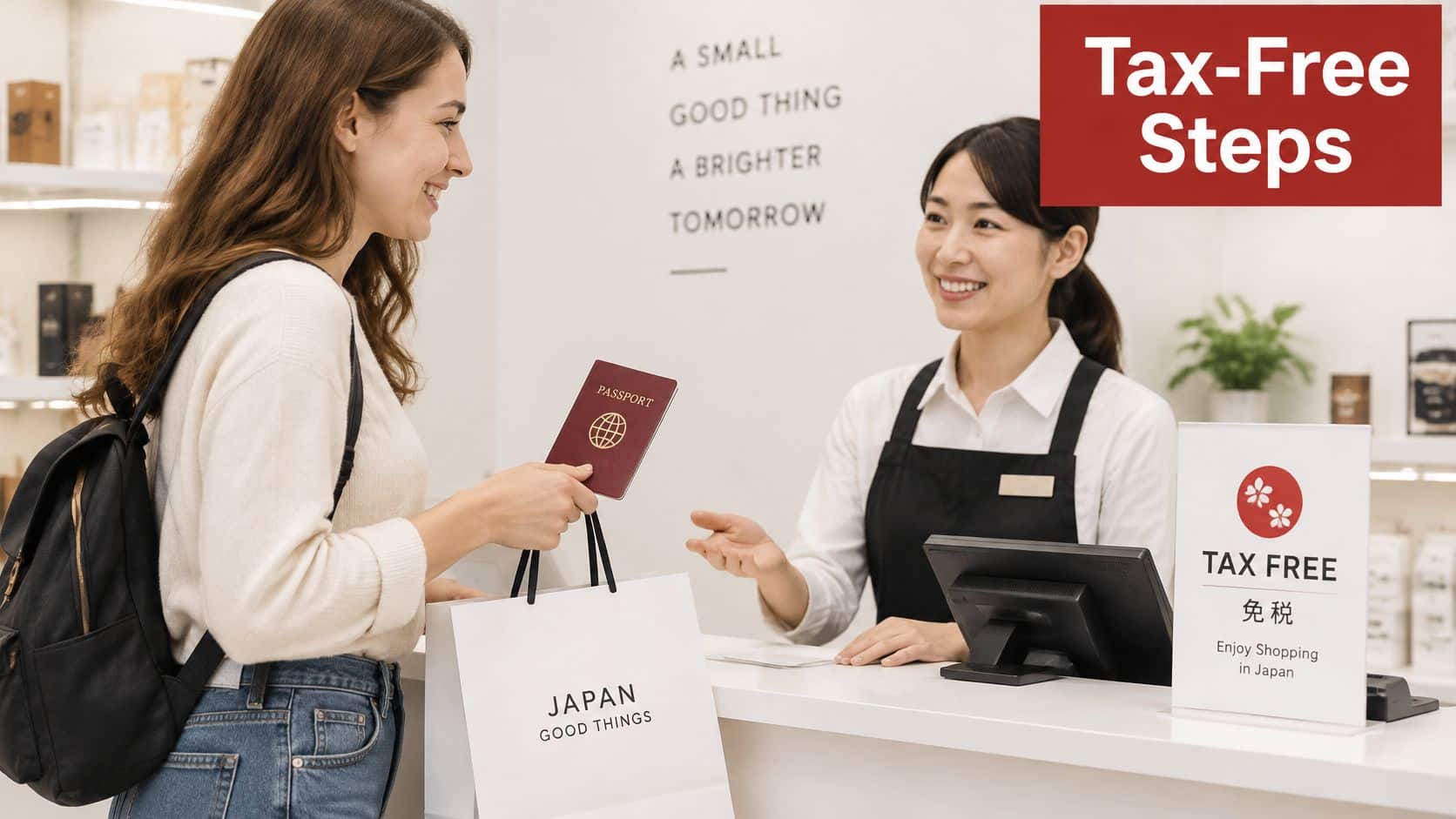
Complete the purchase record properly
Check participation and show your passport. Look for the shop's tax-free sign and present the passport used to enter Japan. Forgetting it can prevent staff from completing the eligibility check.
Confirm the qualifying total before paying. Ask staff which items count towards that shop's tax-exclusive total. Don't assume purchases elsewhere, or every item in your basket, qualify.
Pay the full tax-inclusive price. Use an accepted card or cash and retain the payment record. Expecting a checkout deduction can leave you short of cash or available card credit.
Check the itemised receipt and passport-linked record. Ask for documentation identifying each item and confirm that the transaction is associated with your passport correctly. Passport details may sit in the electronic record rather than appear fully on the printed receipt.
Keep export purchases unused and accessible. As a practical packing precaution, leave food and cosmetics unopened and keep purchases together. Opening something for use during the trip can undermine the refund claim.
Record the purchase date. Add it to your shopping folder or phone notes so you can check the export deadline against your departure. Long stays make this particularly important.
Get the refund instructions in writing. Establish who pays, which channel they use and what action you must take after Customs confirmation. Don't assume reimbursement will arrive during the same week.
A visual explanation can help when discussing the procedure with travelling companions.
Resolve payment and language questions at the counter
Reserve enough cash or card capacity for the full purchase amount. Mazurly's fee-saving guide for digital nomads is a useful companion for reviewing overseas payment charges, which are separate from the Japanese tax refund.
If staff cannot explain the refund route in English, ask them to write it down or involve an English-speaking colleague. Photograph the receipt and refund instructions before leaving, then keep the originals in one folder arranged to match your goods.
How to Clear Customs and Collect Your Refund
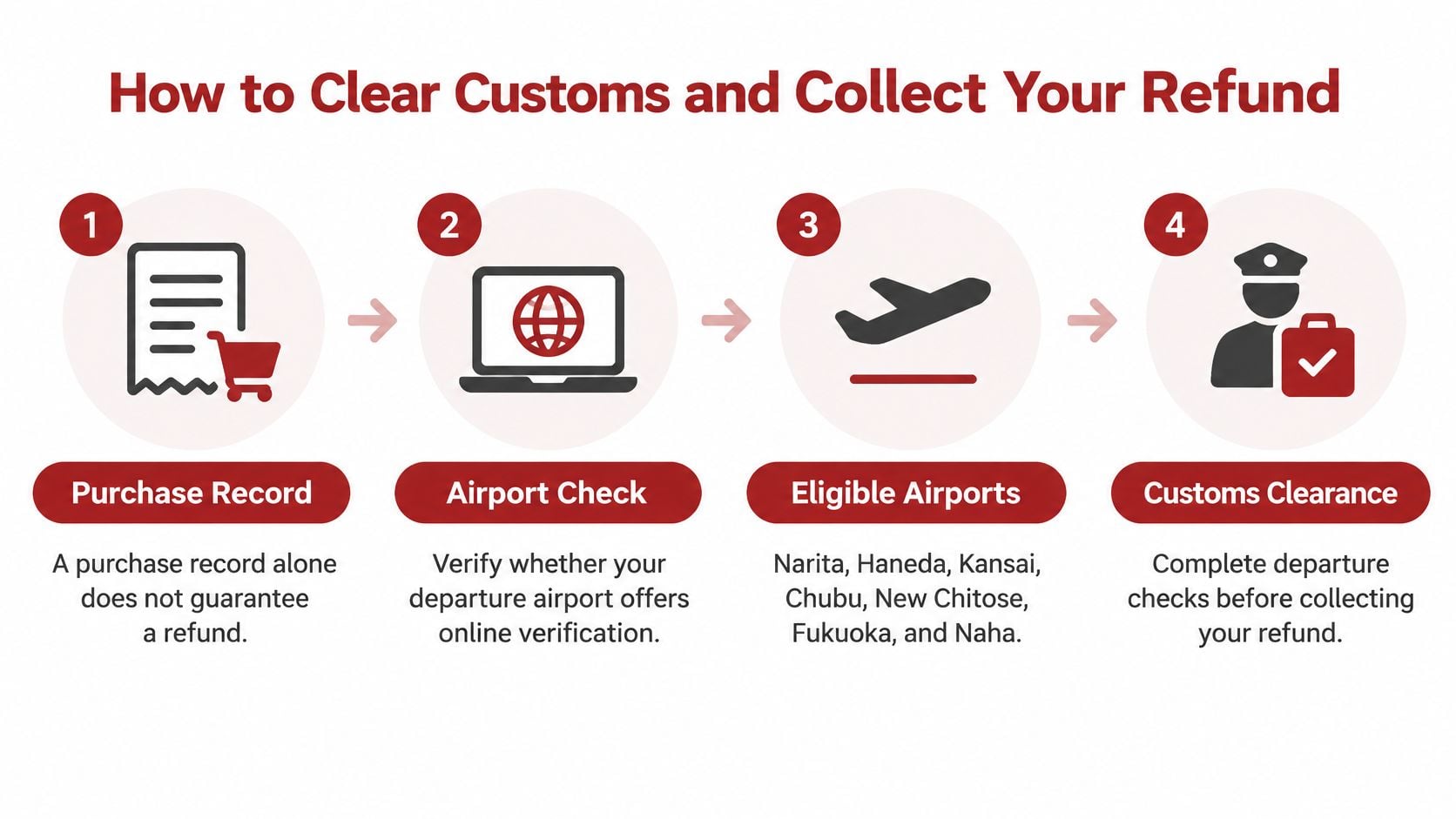
A purchase record alone doesn't guarantee payment. You must complete the departure verification successfully, including any inspection Customs requires.
The National Tax Agency's online verification guide lists Narita, Haneda, Kansai, Chubu, New Chitose, Fukuoka and Naha as supporting the online route. It also explains the designated airport Wi-Fi requirement and the need to attend inspection when the result is Not Completed.
Airports with online Customs verification
| Airport | Online verification |
|---|---|
| Narita | Available |
| Haneda | Available |
| Kansai | Available |
| Chubu | Available |
| New Chitose | Available |
| Fukuoka | Available |
| Naha | Available |
| Other airports and seaports | Terminal or Customs process |
Online verification route
- Prepare Visit Japan Web before departure. Register and have your passport and landing-permission information available. Preparation doesn't replace the airport procedure.
- At the airport, connect to the designated Wi-Fi for the refund procedure. Don't assume an ordinary mobile connection or general airport network will perform the same function.
- Select Refund Procedure and review the recorded purchases. Check that you recognise the transactions rather than pressing through without reading.
- Confirm the result. If it shows Not Completed, take your goods and passport to the Customs inspection area.
- Keep the completed confirmation with your receipts and follow the retailer's refund instructions.
The process below separates having a purchase record from obtaining export clearance.
Terminal or local Customs route
- Find the tax-free procedure terminal or Customs desk before surrendering baggage containing your purchases. Follow the departure location's instructions rather than relying on another airport's layout.
- Complete the passport and purchase-record procedure. If directed to inspection, present the actual goods.
- Retain the confirmation and complete any remaining steps required by the shop or refund partner.
Keep access to your purchases until Customs has finished. A receipt cannot replace goods that an officer needs to inspect.
Allow extra airport time for finding the procedure area and completing an inspection. A busy inspection desk is a departure-planning risk, not a reason for Customs to waive the check.
Hand luggage can make inspection easier, but airline baggage and security restrictions still apply. If purchases must travel in checked baggage, present them before check-in and discuss the sequence with airline staff.
For connecting flights, confirm which airport is your final departure point from Japan and how you'll retain access to purchases during the connection. After clearance, direct payment questions to the shop or its approved refund partner: Customs confirms export; the retailer arranges reimbursement.
Mistakes That Cost Travellers Their Refund
Eating the food, drinking the alcohol or using the cosmetics before departure can destroy the basis of the claim. Those products are no longer available for export in the condition needed for a refund. A tax-free label isn't permission to use them during your stay.
The National Tax Agency's reform leaflet sets out the new export-confirmation framework and removes the former general-goods versus consumables distinction, including the separate ¥500,000 consumables maximum. Removing that classification doesn't remove the export obligation.
Independently sending purchases abroad by international parcel has been ineligible since 1 April 2025, although store-arranged direct shipping may remain possible, according to Japan Customs' shopping guidance.
Common refund mistakes and how to avoid them
| Mistake | What happens | How to avoid it |
|---|---|---|
| Eating, drinking or using cosmetics in Japan | Goods no longer qualify for the refund | Keep them sealed and unused until you leave |
| Sending tax-free goods home by international parcel yourself | Not eligible under the independent-parcel restriction | Ask the shop whether it can arrange direct shipping |
| Giving or transferring goods to someone else before departure | Export condition isn't met and tax may become payable | Keep purchases with the buyer until Customs confirms export |
| Packing tax-free goods in checked baggage | Customs may lose access to goods needed for inspection | Carry them in hand luggage or present them before check-in |
| Skipping Customs or ending with Not Completed | A purchase record exists but the refund cannot proceed | Complete verification or attend the inspection area |
| Assuming tax is deducted at the till | Full payment is required before reimbursement | Budget for the full amount before travelling |
Fix discrepancies before reaching the gate
Check the records against the contents of your luggage while you can still contact the shop. Missing goods, incorrect passport information and unexplained transactions deserve attention before departure day becomes rushed.
For families and tour groups, organise purchases by buyer and transaction, not merely by whoever has spare suitcase space. Everyone should know where their own goods and receipts are.
If you discover a problem, contact the shop and the airport Customs office while there's still time to act. Don't leave a disputed purchase record until boarding.
Frequently Asked Questions
Do I need a Japanese phone number or bank account?
There isn't a single refund channel used by every shop. Ask whether its chosen card, bank-transfer, app or cash process requires a Japanese phone number, domestic bank account or particular payment card, and obtain written instructions before buying.
If an app is involved, check that you can register and access it using your own device and contact details. Don't assume a shop accepting your foreign card means its refund app will accept your overseas phone number.
Can I buy goods and have them sent home?
Don't arrange an international parcel yourself and assume the shopping refund survives. Ask the retailer whether it offers an eligible direct-shipping arrangement and have the tax treatment confirmed before payment.
A delivery service and a tax-free export procedure aren't interchangeable. Keep the shipping documentation with the purchase record if the shop arranges export.
Does my Japanese residence status qualify?
Check the status and entry information shown in your passport or landing permission. Ordinary foreign residency in Japan doesn't create visitor-shopping eligibility.
If you mean a refund of income tax, use the separate National Tax Agency income-tax refund guidance. That involves tax-return documentation, not airport shopping verification.
What if my airport result says Not Completed?
Take your goods and passport to the Customs inspection area. Don't treat the existence of recorded purchases as evidence that verification succeeded.
If you cannot resolve the issue, contact the airport Customs office before your flight. Keep any instructions or reference details so the shop can understand the unresolved issue.
Keep refund categories separate: Consumption-tax reimbursement, accommodation cancellations and ticket refunds follow different rules.
For accommodation planning, MyPerfectStay's booking cancellation and refund details provide a separate reference. A booking refund doesn't alter your obligations for exporting shopping purchases.
Pre-Departure Checklist and Support
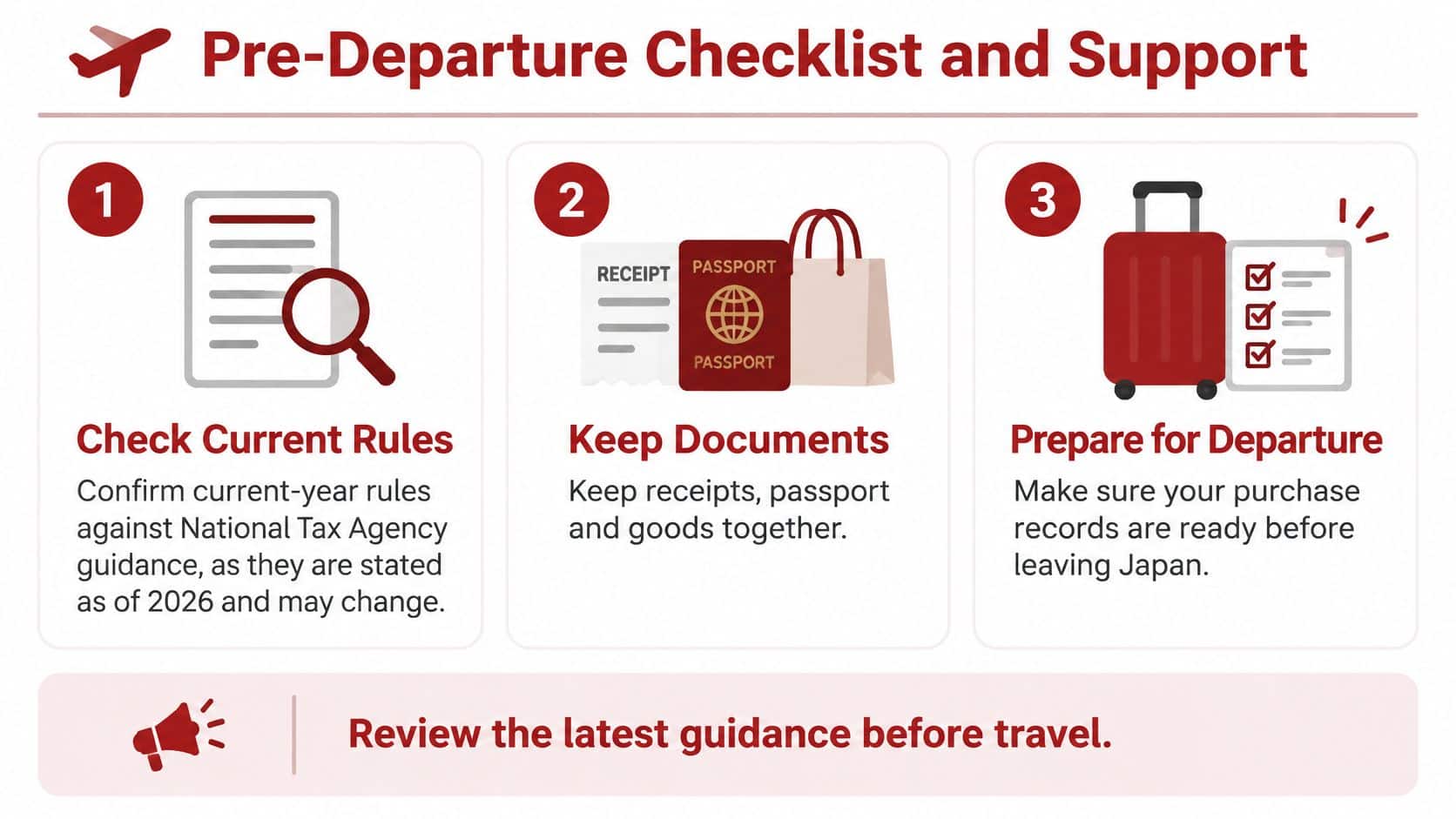
- Confirm current rules. Review National Tax Agency guidance before travel and check for changes affecting your purchase and departure dates.
- Keep documents and goods organised. Put receipts and refund instructions in one accessible folder, with purchases packed so you can identify them quickly.
- Check your landing permission. Resolve doubts about shopping eligibility before committing to an expensive purchase.
- Prepare Visit Japan Web. If your airport supports online verification, set up access before departure and keep your device charged.
- Allow time for Customs. Plan the inspection sequence before checking baggage, including any domestic connection.
- Cover the full purchase price. Leave sufficient card capacity or cash available without relying on the refund to fund the rest of your trip.
Use this visual reminder when preparing your departure documents.
Bilingual help without a Japanese contact number
Jasumo is a Tokyo-based concierge, ticketing and travel services company operated by COMFYS JAPAN LLC. We handle matters directly for clients and work in English and Japanese, with quotes, confirmations and entry instructions provided in English.
Customers don't need a Japanese phone number or address to use our services. We provide the Japanese phone number, address and payment that a sale requires; you only need WhatsApp or an email address. These arrangements don't replace your own passport, shopping eligibility or Customs obligations, and no outcome is guaranteed.
Visit Jasumo for practical bilingual support when Japanese-language shopping enquiries or travel arrangements are difficult to handle from abroad. Contact our bilingual team through the contact form for help with tickets, restaurant reservations, Japanese-language calls, payments, deliveries, group travel or other arrangements, including clarifying a shop's refund instructions before you buy.
Planning a Group Trip to Japan?
From corporate teams to friends traveling together, we create tailor-made travel packages. Enjoy VIP access, curated itineraries, and full support from our local experts. Tell us your plans, and we’ll handle the rest.
Contact Jasumo Now →
