
Everything You Ever Wanted to Know About the Mawashi (And Some Things You Might Not!)
What is a Mawashi and Why Is It So Important in Sumo?
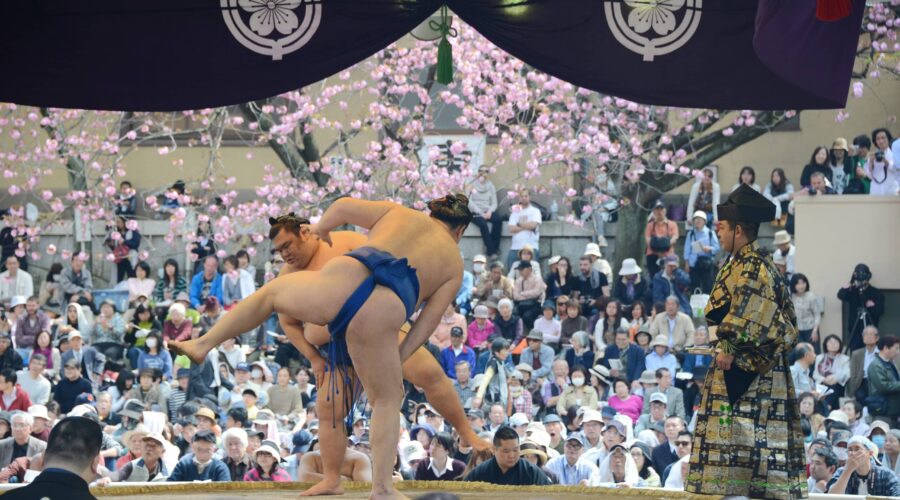
If you know only one thing about sumo wrestling, it’s probably the image of two enormous wrestlers facing off wearing nothing but a thick belt. That belt is called the mawashi, and it’s not just a piece of clothing — it’s the single most essential item in the sport. Without it, you don’t have real sumo.
Are you Visiting Japan soon?
Let us make your trip effortless. From tickets and hotels to transport and local guides, we arrange everything for you or your group. Whether it’s a music festival in Tokyo or a business conference in Osaka, our custom travel service ensures you enjoy the event stress-free.
Contact Jasumo Now →Yes, the dohyo (sumo ring) is important, but rikishi (sumo wrestlers) can and do train outside of a proper ring, even in public parks, where they mark the boundaries with a rope or chalk. But a mawashi is non-negotiable. It is to sumo what gloves are to boxing or a gi is to judo — the fundamental, defining piece of gear.
The mawashi has its origins in the fundoshi, a traditional Japanese loincloth worn by laborers, festival participants, and in some martial arts. Over time, it evolved into a stronger, wider, and more supportive garment that not only covers and protects the wrestler but also offers the critical handholds that are central to sumo technique.
Different Types of Mawashi: Training vs. Competition
Professional sumo wrestlers have different mawashi for different purposes, but in amateur sumo, wrestlers often use the same mawashi for both training and matches.
In professional sumo:
- Lower division rikishi (Makushita and below) use cotton practice mawashi in both training and competition, usually black in color.
- Sekitori (Juryo division and above) have separate training mawashi and competition mawashi (shimekomi).
Training Mawashi
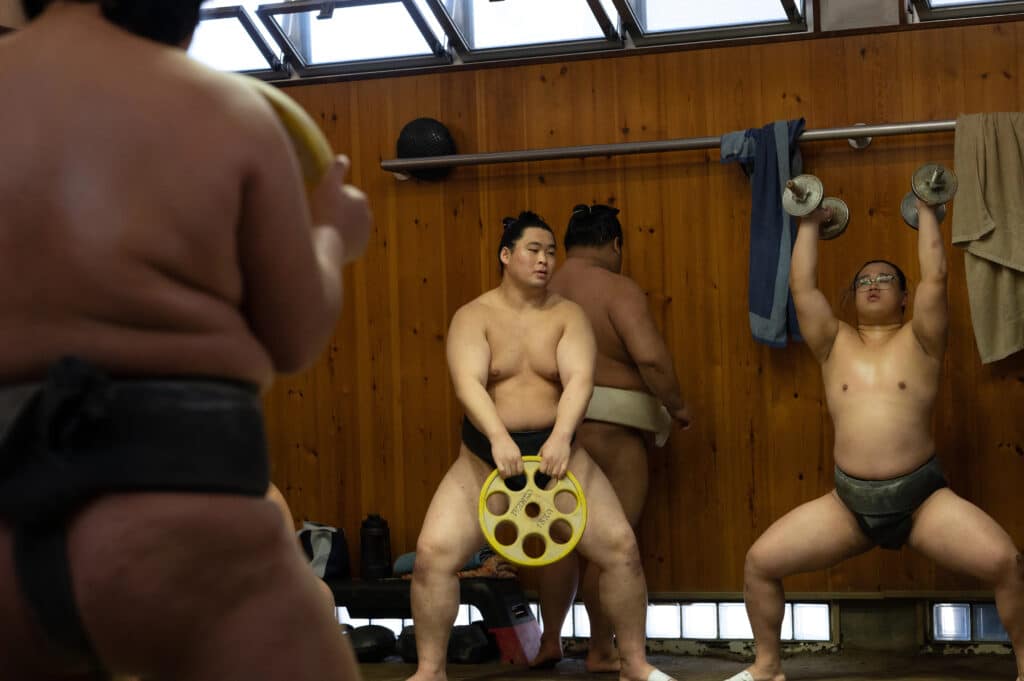
Made from heavy cotton drill or canvas, these are built for durability, not glamour. They are stiff, coarse, and designed to withstand the rigors of daily keiko (practice).
- Amateur wrestlers may wear clothing underneath (leotards for women, shorts for men).
- Lower-division professionals wear theirs directly against the skin, with no undergarments, in keeping with tradition.
In professional stables, the color and folding style of the mawashi signals rank and status.
- Lower-division wrestlers fold the front end under the belt in a triangular fashion.
- Sekitori fold it in the “toilet-paper roll style” (rolled at the front and tucked into the top), a visible badge of honor permitted only for top-division wrestlers and oyakata (retired wrestlers turned coaches).
The Competition Mawashi (Shimekomi)
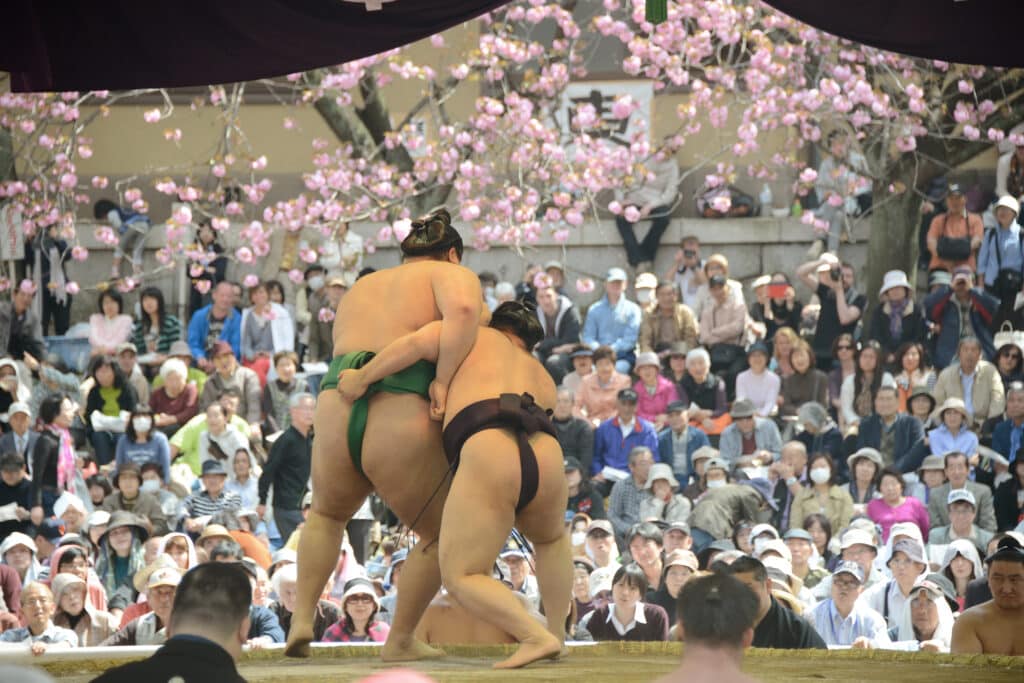
For tournaments, sekitori wear the shimekomi — a competition mawashi made from satin silk, 80 cm wide, weighing around 4.5 kg. Unlike training mawashi, these are works of art, often gifted by supporters and costing up to ¥1,000,000 (about $6,500 USD).
Key details:
- Comes with a matching sagari, made from the same silk. The sagari strands are stiffened with glue, hanging like skewers during the tachiai (initial charge).
- Officially, colors were limited to purple or dark blue, but TV changed that — today, rikishi wear many colors, except white (taboo for competition).
- Tied in the same TP-roll style as a training mawashi when worn for practice to “break it in.”
Kesho-Mawashi: Ceremony and Symbolism
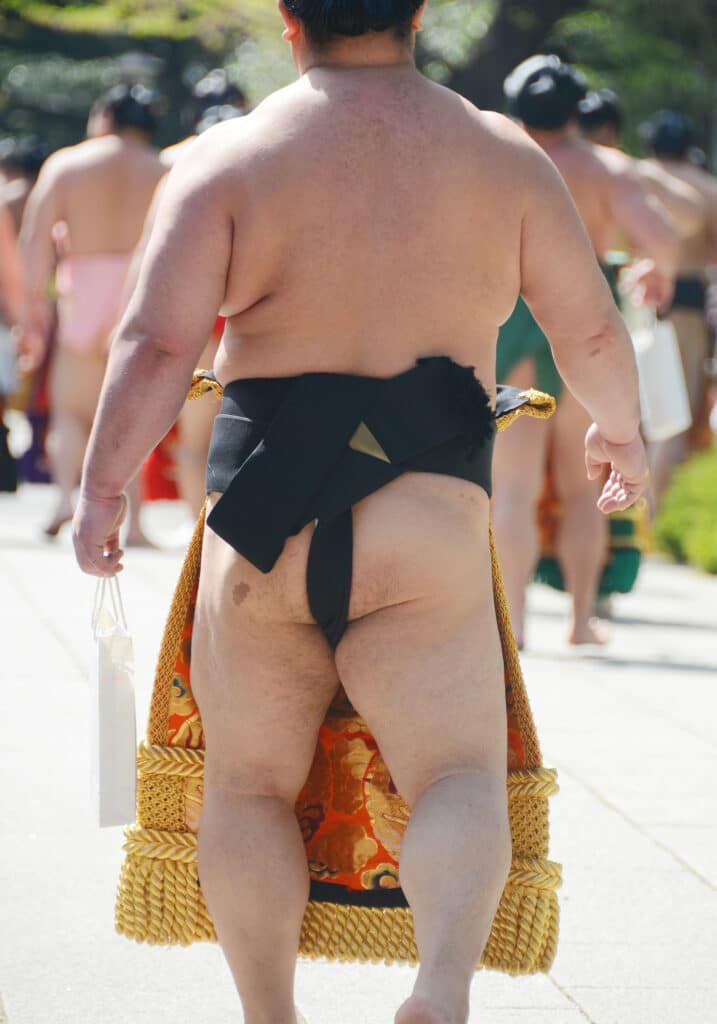
The third type of mawashi is the kesho-mawashi, worn for ceremonial entrances (dohyo-iri). This is the highly decorative apron-style belt, often embroidered with elaborate imagery: dragons, tigers, cherry blossoms, or sponsor logos.
- Only worn over a fundoshi (loincloth), never directly on the skin.
- Yokozuna kesho-mawashi come in sets of three — one for the yokozuna, two for his attendants.
- These are not washed, in keeping with tradition.
The Sagari: More Than Decoration
The sagari — those colorful strings hanging from the front of the mawashi — are not just for show. They serve two purposes:
- Identification — often displaying stable colors or matching the mawashi material.
- Psychological factor — part of sumo’s aesthetic and ceremonial traditions.
They are always odd-numbered (usually 13–25) and stiffened to stand upright during the squat at the start of a match.
The “Never Washed” Rule
One of the most surprising facts for newcomers: mawashi are never washed.
- The belief is that washing them would remove the fighting spirit and good luck accumulated over time.
- Practice mawashi may be scrubbed for mud with a deck brush, but no soap or water is used.
- Competition silk mawashi are spot-cleaned with damp cloths or stain remover.
Mawashi are only washed:
- Before their first use
- Upon the death of the stablemaster (shisho)
The smell? Let’s just say it’s part of the culture — and another reason a rikishi takes his own mawashi everywhere.
The Stolen Mawashi Incident
In one famous case at Takasago stable, a mawashi belonging to wrestler Terasawa was stolen while hanging out to dry. The culprit arrived in a minivan, grabbed the belt, and vanished. The cost to replace? ¥800 ($7.50 USD) — but the real loss was sentimental: inside was a lucky charm containing the ashes of Terasawa’s childhood pet rabbit, Raruki.
Why steal such a thing? No one knows. In sumo circles, the incident remains one of the oddest thefts ever recorded.
Making a Mawashi: Craftsmanship and Tradition
Cotton mawashi are cut from 100-meter rolls kept by the Nihon Sumo Kyokai (NSK), priced at:
- ¥800 for a black cotton mawashi (lower ranks)
- ¥950 for a white cotton mawashi (sekitori practice)
Silk shimekomi, on the other hand, are handmade on traditional looms — often by artisans like Mr. Nakagawa of Nagahama City, Shiga Prefecture. It takes two men about 10 days to produce one, and the busiest period is after Juryo promotions are announced.
How to Wear a Mawashi
Donning a mawashi is a skill — and a workout.
- The belt is folded (often using beer bottles to crease it) and rolled for storage.
- Certain parts are folded differently:
- Four layers for most of the length
- Two layers in front
- Eight layers through the back
- It’s tied tightly at the back, often requiring assistance from another wrestler.
Once tied, the mawashi stays put — unless the back knot loosens during a match, in which case the gyoji (referee) must fix it.
Cultural Etiquette and Superstition
In professional sumo:
- Wrestlers relieve themselves and clean thoroughly before putting on the mawashi.
- No undergarments are worn (except bandaging for injury).
- Removing the mawashi in public is a serious breach of etiquette.
Why the Mawashi Matters to Sumo Fans
The mawashi is more than sports gear — it’s a visible sign of rank, status, and tradition. Watching a Yokozuna in a glittering kesho-mawashi or a sekitori in brightly colored silk adds to the grandeur of the sport.
For fans attending a tournament, understanding the nuances of the mawashi — its colors, folds, and accessories — adds depth to the experience.
Where to See the Mawashi in Action
You can witness the mawashi in all its forms at any of Japan’s six annual honbasho tournaments:
- January (Tokyo) – Hatsu Basho
- March (Osaka) – Haru Basho
- May (Tokyo) – Natsu Basho
- July (Nagoya) – Nagoya Basho
- September (Tokyo) – Aki Basho
- November (Fukuoka) – Kyushu Basho
Typical ticket prices:
- Box seats (4 people): ¥38,000–¥50,000 per box
- Arena seats: ¥3,800–¥9,800 per person
- Premium ringside: ¥14,800–¥20,000 per person
FAQ – Mawashi & Sumo Gear
Q1: What is a mawashi in sumo wrestling?
A mawashi is the thick belt worn by sumo wrestlers, made from cotton for training or satin silk for competition. It’s essential for both grip and support during bouts and has deep cultural and traditional significance in sumo.
Q2: Why don’t sumo wrestlers wash their mawashi?
Traditionally, mawashi are never washed to preserve the wrestler’s fighting spirit and luck. They are only cleaned before first use or after the death of a stablemaster. Spot cleaning is done for stains, but no full washing occurs.
Q3: What is the difference between a training mawashi and a competition mawashi?
Training mawashi are made of heavy cotton and are durable for daily practice, while competition mawashi (shimekomi) are made of satin silk, more colorful, and accompanied by stiffened sagari.
Q4: What is a kesho-mawashi?
A kesho-mawashi is a decorative apron-style belt worn during ceremonial ring-entering (dohyo-iri). It is richly embroidered and symbolizes the wrestler’s rank, sponsors, or stable.
Q5: How much does a mawashi cost?
A black cotton mawashi for lower-division rikishi costs around ¥800, while a white cotton mawashi for sekitori costs ¥950. Competition silk mawashi can cost up to ¥1,000,000, often funded by supporters.
Q6: How is a mawashi tied?
The mawashi is folded, creased, and tightly wrapped around the wrestler’s body, with the knot secured at the back. Tying often requires assistance from another wrestler due to the strength and precision needed.
Q7: What are sagari in sumo?
Sagari are stiffened strings hanging from the front of the mawashi, usually in odd numbers. They serve as decorative elements and indicate the wrestler’s stable or match attire.
Q8: Do sumo wrestlers wear anything under their mawashi?
No, professional rikishi wear nothing under their mawashi, except for injury bandaging. In amateur sumo, wrestlers may wear shorts or leotards underneath.
Q9: Can you buy a sumo mawashi as a fan?
Yes, replica mawashi and fundoshi are available for purchase as souvenirs or for amateur practice, though official professional mawashi are supplied through the Japan Sumo Association.
Q10: Where can I see mawashi in action?
You can see mawashi in use at any of the six annual sumo tournaments in Japan — Tokyo (Jan, May, Sep), Osaka (Mar), Nagoya (Jul), and Fukuoka (Nov). Tickets can be booked at Jasumo.com.
Experience Sumo with Jasumo.com and OmoriWiFi.com
There’s nothing like seeing sumo live — the thunder of feet on the dohyo, the ritual stomps, and the flash of colorful mawashi. Jasumo.com makes it easy for tourists and foreign residents to book tickets, with English-friendly support and curated experiences that go beyond the match.
Traveling to Japan? Stay connected with OmoriWiFi.com — your reliable source for tourist SIM cards and pocket Wi-Fi with nationwide coverage. Never miss a sumo result or a photo opportunity.
Book your sumo tickets now with Jasumo.com and secure your OmoriWiFi SIM to experience the best of Japan’s national sport.
Planning a Group Trip to Japan?
From corporate teams to friends traveling together, we create tailor-made travel packages. Enjoy VIP access, curated itineraries, and full support from our local experts. Tell us your plans, and we’ll handle the rest.
Contact Jasumo Now →