
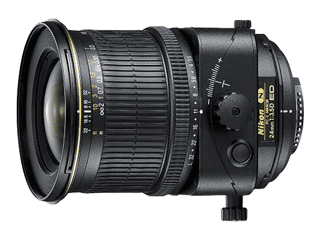

Product Summary:
The Nikon PC-E NIKKOR 24mm f/3.5D ED is a professional Perspective Control (PC) lens available for rent in Japan, offering both shift and tilt movements. This wide-angle lens is essential for high-end architectural, landscape, and interior photography, where managing perspective and depth of field is critical.
Are you Visiting Japan soon?
Let us make your trip effortless. From tickets and hotels to transport and local guides, we arrange everything for you or your group. Whether it’s a music festival in Tokyo or a business conference in Osaka, our custom travel service ensures you enjoy the event stress-free.
Contact Jasumo Now →The 24mm focal length provides an 84 degree angle of view, making it highly effective for wide scenes. Its design allows for flexible composition, featuring a revolving mechanism for rotating the lens barrel, and includes 3 ED elements, 3 Aspherical elements, and the Nano Crystal Coat for outstanding image quality.
Quick Highlights:
- Perspective Control (PC): Equipped with shift (for perspective correction) and tilt (for depth of field control) mechanisms.
- Wide-Angle Coverage: The 24mm focal length is ideal for architectural and landscape photography on FX cameras.
- Revolving Mechanism: Allows the entire lens barrel to rotate within a 90 degree range (left and right) for flexible orientation of the shift/tilt movements.
- Nano Crystal Coat: Effectively reduces ghosting and flare, crucial when shooting wide-angle against bright light.
- Premium Optics: Features 3 ED and 3 Aspherical elements to minimize distortion and aberrations.
- Handheld Capable: Enables tilt-shift photography without the bulk of a large-format view camera setup.
- Manual Focus Only: Provides precise control necessary for utilizing tilt and shift movements.
Product Details / Description:
This 24mm PC-E lens is the wide-angle workhorse for photographers needing precise control over geometric perspective. The Shift function is invaluable for preventing tall structures, like temples or skyscrapers, from appearing to lean backward (converging vertical lines). The Tilt function allows for selective manipulation of the focal plane, enabling maximum sharpness from a close foreground element to a distant background even at a relatively wide aperture.
About the Product
The PC-E NIKKOR 24mm f/3.5D ED features an optical construction of 13 elements in 10 groups. This complex design includes three Extra-low Dispersion (ED) elements and three Aspherical lens elements, which work together to ensure high resolution and correct aberrations inherent in wide-angle tilt-shift lenses.
The lens uses an electronic diaphragm (E-type) but is manual focus only. Its primary feature is the full movement control: plus or minus 11.5 mm of shift and plus or minus 8.5 degrees of tilt. The ability to rotate the lens barrel allows the photographer to orient the shift and tilt movements independently of the camera’s orientation (portrait or landscape). It boasts a close minimum focusing distance of 0.21m.
Key Features
- Wide 24mm perspective for capturing expansive scenes.
- Shift and Tilt functions provide professional perspective and focus control.
- Revolving mechanism offers flexible composition control.
- Close minimum focusing distance of 0.21m.
- Professional 77mm filter size.
Technical Specifications
| Feature | Specification |
| Focal Length | 24mm |
| Maximum Aperture | f/3.5 |
| Lens Construction | 13 elements in 10 groups (3 ED, 3 Aspherical) |
| Filter Size | 77mm |
| Minimum Focusing Distance | 0.21m |
| Weight | Approx. 730g |
What’s in the box (Included Items):
- PC-E NIKKOR 24mm f/3.5D ED Lens
- Lens Hood
- Front Lens Cap
- Rear Lens Cap
- Soft Case
- Protection Filter (attached to the lens)
- QR code for viewing the instruction manual
Where This Product Can Be Used:
- Architectural Photography: Correcting perspective to make buildings look structurally sound.
- Landscape Photography: Using the tilt function (Scheimpflug principle) to achieve edge-to-edge sharpness from foreground to infinity.
- Interior Photography: Capturing wide indoor spaces with straight, parallel lines.
- Creative Miniaturization (Tilt Effect): Creating the popular “miniature” or “diorama” effect.
Why Tourists Rent From Us
- English-speaking customer support for easy communication.
- Accept foreign credit cards for hassle-free payment.
- No Japanese phone number required for booking or communication.
- Offer hotel & Airbnb delivery across major Japanese cities.
- Easy return for travelers with convenient shipping options.
Book with Jasumo:
If you are ready to rent this product, you can contact us with the Product Name, the Rental start date and end date, your delivery Location, and other important details you want to share. After we get a request from you, our team will start communicating with you as soon as possible.
Faqs:
What is the primary purpose of the ‘shift’ function in architectural photography?
The primary purpose of the shift function is perspective correction. When you point a regular camera up to photograph a tall building, the vertical lines appear to converge toward the top. By shifting the lens upward, you keep the camera body level (maintaining parallel vertical lines) while effectively raising the image circle, thus correcting the converging verticals.
Why is this lens manual focus only and not autofocus?
Perspective Control (PC) lenses are manual focus only because the precise manipulation of the image plane using the tilt function is extremely complex. Autofocus systems cannot adequately account for the Scheimpflug principle used by the tilt movement, making manual focus necessary for accurate adjustment and the highest quality results.
What does the revolving mechanism allow the photographer to do?
The revolving mechanism allows the photographer to rotate the lens barrel (and thus the axis of the tilt and shift movements) independent of the camera body. For example, if the camera is held horizontally (landscape), you can rotate the lens by 90 degrees to apply vertical shift for perspective correction, or rotate it to 45 degrees for diagonal tilt effects. This provides tremendous compositional flexibility.
How does the Nano Crystal Coat benefit this wide-angle lens?
Wide-angle lenses are prone to internal reflections because they capture a huge field of view, making it difficult to exclude bright light sources. The Nano Crystal Coat is an anti-reflective coating that drastically reduces flare and ghosting, ensuring that high-contrast scenes (like cityscapes at night or interiors with strong window light) maintain deep blacks and high contrast.
Why is there a warning about the lens potentially contacting and scratching the camera body?
Due to the mechanical complexity and large diameter of the lens barrel required for the shift and tilt movements, on some older or smaller Nikon camera bodies (particularly some DX models), the lens barrel or the movement knobs may physically interfere with the camera’s prism housing or flash head when extreme shift or tilt movements are applied, leading to potential scratches. Users must check their camera compatibility before using the full range of motion.
Planning a Group Trip to Japan?
From corporate teams to friends traveling together, we create tailor-made travel packages. Enjoy VIP access, curated itineraries, and full support from our local experts. Tell us your plans, and we’ll handle the rest.
Contact Jasumo Now →


Leave a Reply